

RecQ family helicases are conserved from bacteria to humans, with more complex organisms generally encoding multiple family members (e.g., one in E. coli and five in humans). These enzymes are well known for their roles in DNA recombination, but they also function in DNA replication, repair, telomere maintenance, and transcription, as well as have mitochondrial functions. Notably, mutations in three of the five human RecQs (BLM, WRN, and RECQ4) are associated with diseases characterized by predispositions to cancer and/or premature aging.
RecQ Family Helicases
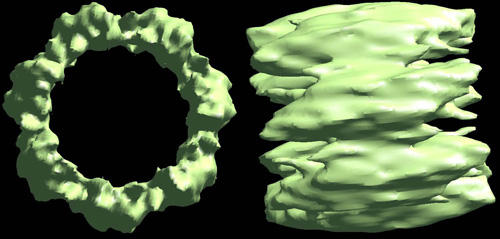
Low resolution 3D reconstruction of the S. cerevisiae Hrq1 heptameric structure.
Single particles of purified Hrq1 were semi-automatically picked from negatively stained transmission electron micrographs, rotationally aligned and averaged into class averages, and built into a 3D structure using EMAN2 software.Our current focus in the lab is on RECQ4 and using its S. cerevisiae homolog Hrq1 as a simple model to determine why mutation of human RECQ4 leads to three different diseases: Rothmund-Thomson Syndrome, Baller-Gerold Syndrome, and RAPADILINO. We’re using biochemistry, mass spectrometry, and yeast genetics to determine the substrate specificities of these enzymes and their in vivo interactomes.